
The anime renaissance that began in the 1980s and peaked throughout the 1990s and early 2000s produced some of the most influential, artistically ambitious, and narratively transcendent works ever created in the medium. These masterpieces weren’t created with streaming accessibility, algorithmic promotion, or monetization cycles in mind—they were born from genuine creative vision, unconventional storytelling, and the freedom to take risks that modern production demands increasingly restrict. From Hayao Miyazaki’s hand-drawn masterworks to the psychological depths of Neon Genesis Evangelion, from the revolutionary hip-hop aesthetic of Cowboy Bebop to the alchemical perfection of Fullmetal Alchemist, these ten series represent a golden age of anime that established conventions modern series now simply follow rather than reinvent. While contemporary anime certainly possesses technical advantages—superior animation software, deeper budgets, and global streaming access—it arguably lacks the artistic daring, narrative complexity, and willingness to challenge audiences that defined these foundational classics. These ten old-school anime masterpieces remain not just watchable but essential viewing, representing creative heights that continue to influence and inspire despite belonging to a different era of production.
10 Old-School Anime Masterpieces That Modern Series Will Never Surpass
1. Cowboy Bebop (1998-1999)
Creator: Shin’ichirô Watanabe | Studio: Sunrise | Episodes: 26 | IMDB Rating: 8.9/10 (161K votes) | MyAnimeList Score: 8.73 | Genre: Sci-Fi, Neo-Noir, Jazz, Western
Shin’ichirô Watanabe’s Cowboy Bebop remains the gold standard of atmospheric anime storytelling. Set in a futuristic solar system where bounty hunters navigate episodic adventures amid an underlying tragic mythology, the series transcends genre classification entirely. Its hip-hop aesthetic, revolutionary jazz soundtrack by Yoko Kanno, and perfect character ensemble (Spike, Jet, Faye, Ed, Ein) created a show that defined anime for an entire generation. The series works equally well dubbed or subbed, demonstrating mastery across both performance dimensions. Modern anime, constrained by streaming formulas and algorithm optimization, struggles to replicate Bebop’s perfect balance of episodic storytelling, thematic depth, and coolness factor that feels unforced and authentic.
2. Neon Genesis Evangelion (1995-1996)
Creator and Director: Hideaki Anno | Studio: Gainax | Episodes: 26 | IMDB Rating: 8.5/10 (104K votes) | MyAnimeList Score: 7.57 | Genre: Sci-Fi, Psychological, Mecha, Drama
Hideaki Anno’s Neon Genesis Evangelion fundamentally altered anime’s artistic possibilities by introducing psychological complexity, existential dread, and genuine mental health representation into the mecha genre. The series follows Shinji Ikari, a teenager forced to pilot massive robots against alien entities, but the true narrative explores trauma, identity, depression, and the impossibility of human connection. Anno deliberately rejected conventional storytelling, with the final two episodes deconstructing the medium itself through avant-garde animation and philosophical monologue. Decades later, Evangelion remains unmatched in its psychological penetration and willingness to challenge audience expectations. Modern anime rarely attempts such thematic ambition, instead prioritizing commercial accessibility and predictable narrative structures.
3. Fullmetal Alchemist: Brotherhood (2009-2010)
Director: Yasuhiro Imagawa | Studio: Bones | Episodes: 64 | IMDB Rating: 9.1/10 (233K votes) | MyAnimeList Score: 9.08 | Genre: Fantasy, Action, Adventure, Drama
Fullmetal Alchemist: Brotherhood stands as arguably the most perfectly executed anime adaptation ever created. Faithfully adapting Hiromu Arakawa’s manga while enhancing its thematic depth, the series explores alchemy, government corruption, sacrifice, redemption, and the cost of ambition. Edward and Alphonse Elric’s journey—attempting to resurrect their mother through forbidden alchemy—cascades into a narrative touching nearly every character with genuine emotional weight. The series’ ability to balance humor, action, character development, and philosophical exploration across 64 episodes represents a mastery of pacing that contemporary anime rarely achieves. Modern series struggle to justify extended episode counts; Fullmetal Alchemist: Brotherhood proves long-form storytelling can be flawless.
4. Ghost in the Shell: Stand Alone Complex (2002-2003)
Director: Kenji Kamiyama | Studio: Production I.G | Episodes: 26 | IMDB Rating: 8.4/10 | Genre: Sci-Fi, Psychological, Thriller, Police Procedural
Kenji Kamiyama’s adaptation of Masamune Shirow’s Ghost in the Shell universe created a sophisticated police-thriller anime exploring artificial intelligence, consciousness, identity, and what constitutes humanity. Major Motoko Kusanagi—a cyborg with a fully artificial body—investigates increasingly bizarre crimes, gradually uncovering a conspiracy that threatens fundamental reality. The series blends philosophical inquiry with genuine thriller elements, maintaining intellectual rigor across standalone episodes and overarching narrative. Modern anime has largely abandoned this intelligent, slow-burn approach in favor of faster pacing and more immediate gratification. Ghost in the Shell remains the template for anime that trusts audiences to engage with complex ideas.
5. Trigun (1998)
Director: Satoshi Nishimura | Studio: Madhouse | Episodes: 26 | MyAnimeList Score: 7.85 | Genre: Sci-Fi Western, Action, Adventure, Comedy, Drama
Trigun masterfully blends sci-fi western aesthetics with profound philosophical questions about violence, pacifism, and redemption. Vash the Stampede—a powerful fugitive pursued by insurance agents—journeys across a desert planet, leaving mayhem in his wake while secretly harboring a deep commitment to nonviolence. The series constructs entertaining gunslinging sequences while never abandoning subtle exploration of psychological and philosophical themes. The character of Vash remains one of anime’s greatest protagonists—a paradox of power wielded through restraint. While the recent remake Trigun: Stampede boasts superior animation, many fans prefer the original’s narrative cohesion, character depth, and thematic consistency. The original Trigun has achieved “no bad episodes” status—a distinction modern anime rarely claims.
6. Rurouni Kenshin: Trust and Betrayal OVA (2000)
Director: Kazuhiro Furuhashi | Studio: Deen | Episodes: 4 OVA episodes | MyAnimeList Score: 8.76 | Genre: Historical, Action, Drama, Samurai
The Rurouni Kenshin prequel OVA Trust and Betrayal represents anime at its artistic peak—a gorgeous, perfectly paced four-episode narrative that explores Kenshin’s tragic past during Japan’s Bakumatsu period. Utilizing a watercolor aesthetic that feels handcrafted and deliberate, the OVA tells an intimate love story within the context of historical upheaval. The animation quality, emotional authenticity, and historical-romantic atmosphere create an experience that transcends typical action-anime conventions. Modern anime’s preference for television series over OVAs has sacrificed the careful craftsmanship that defined projects like this, where every frame received meticulous attention.
7. Princess Mononoke (1997)
Director and Writer: Hayao Miyazaki | Studio: Studio Ghibli | Runtime: 134 minutes | MyAnimeList Score: 8.67 | Genre: Fantasy, Adventure, Historical, Drama
Hayao Miyazaki’s Princess Mononoke transcends anime classification entirely, standing as one of cinema’s greatest achievements regardless of medium. Set during Japan’s Muromachi period, the film explores the collision between human civilization and nature through the eyes of Ashitaka, caught between the warrior Princess Mononoke and humans seeking to exploit the forest. Miyazaki’s hand-drawn animation remains unmatched—combining technical mastery with genuine emotional authenticity. The film refuses simplistic moral positioning, instead presenting complexity where neither side is entirely right or wrong. Modern animated cinema has embraced CGI rendering, inadvertently abandoning the painstaking handcraft that defined Miyazaki’s approach. No contemporary anime film surpasses Princess Mononoke’s thematic richness or visual poetry.
8. Perfect Blue (1997)
Director: Satoshi Kon | Studio: Madhouse | Runtime: 81 minutes | MyAnimeList Score: 8.21 | Genre: Psychological Thriller, Drama
Satoshi Kon’s Perfect Blue pioneered psychological thriller anime, following Mima—a pop-idol-turned-actress—as her identity fragments under the pressures of celebrity reinvention. Kon’s innovative use of visual distortion, narrative fragmentation, and meta-commentary on performance versus reality creates a disorienting yet intellectually compelling experience. The film influenced Christopher Nolan’s Requiem for a Dream and remains a masterclass in unreliable narration. Modern psychological anime, while technically proficient, rarely exhibits Kon’s willingness to completely disorient audiences while maintaining narrative coherence. Perfect Blue validates anime’s capacity for challenging, adult-oriented storytelling—a category modern anime rarely explores with Kon’s artistic courage.
9. Serial Experiments Lain (1998)
Director: Ryûtarô Nakamura | Studio: Triangle Staff | Episodes: 13 | MyAnimeList Score: 7.72 | Genre: Sci-Fi, Psychological, Thriller, Supernatural
Serial Experiments Lain remains one of anime’s most enigmatic and philosophically ambitious works, exploring consciousness, identity, and the nature of reality through the journey of Lain Iwakura. The series employs surreal imagery, non-linear narrative structure, and cryptic symbolism to examine questions about technology, interconnectedness, and what constitutes self. Each episode demands active engagement; passive viewing yields minimal comprehension. Modern anime overwhelmingly prioritizes accessibility and narrative clarity; Lain’s deliberate opacity and challenge to audience expectations represent a willingness to alienate casual viewers for the sake of artistic integrity. The series has achieved cult-classic status precisely because it refuses compromise.
10. Dragon Ball Z (1989-1996)
Director: Daisuke Nishio | Studio: Toei Animation | Episodes: 291 | IMDB Rating: 8.0/10 | MyAnimeList Score: 8.48 | Genre: Action, Adventure, Comedy, Martial Arts
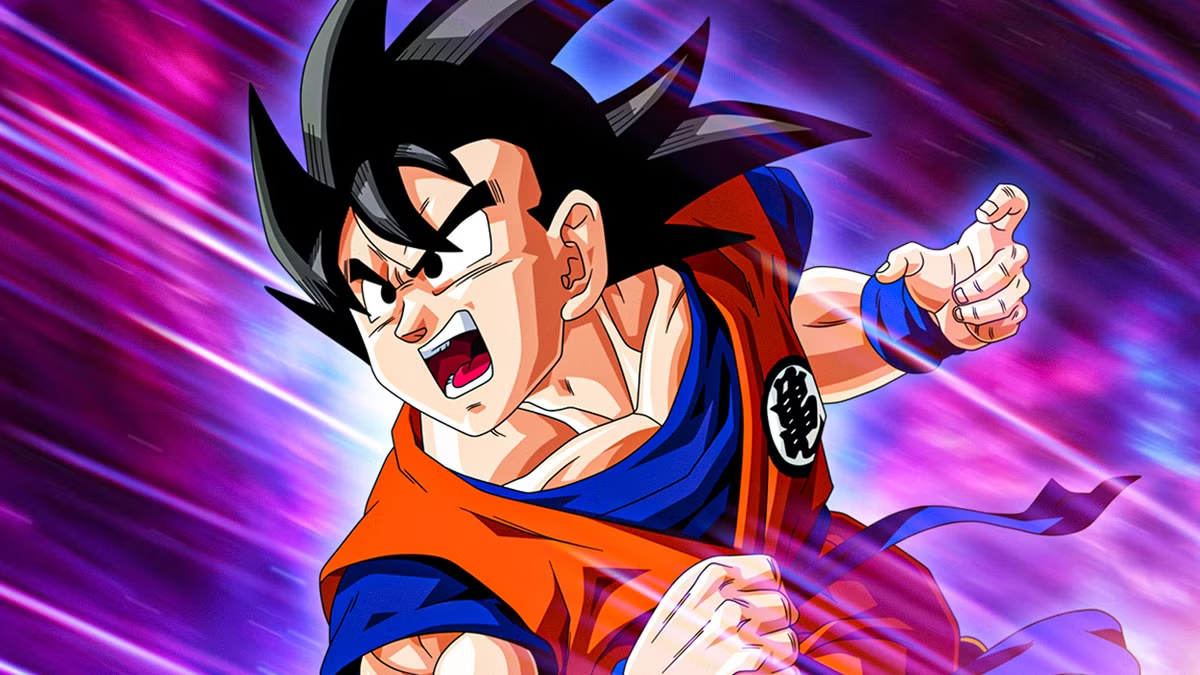
Dragon Ball Z defined the shonen action anime template that contemporary series still follow. Daisuke Nishio’s direction transformed Akira Toriyama’s manga into television gold, creating fighting sequences with genuine stakes, character development arcs that genuinely evolved protagonists, and a sense of scope that made the world feel consequential. Goku’s continuous growth, Vegeta’s redemption arc, and the exploration of martial arts mastery established patterns now ubiquitous in anime. While modern action anime possess superior animation technology, they rarely match DBZ’s pacing—the series allowed fights to breathe, permitted quiet character moments amid action spectacle, and resisted the urge to overstuff episodes with plot progression. Modern action anime often confuse rapid-fire pacing with entertainment; DBZ proved patience yields greater satisfaction.
Where to Watch Classic Anime
Primary Streaming Platforms: Crunchyroll, Netflix, Amazon Prime Video, Hulu, HBO Max, HIDIVE, RetroCrush (specializes in classic anime), Tubi (free with ads)
Availability Note: Classic anime availability varies significantly by region and platform. Many older series have licensing limitations that restrict where they can stream. RetroCrush specifically specializes in 1980s, 1990s, and early 2000s anime, making it the optimal platform for accessing classic titles. Some series remain available only through physical media (DVD/Blu-ray), which many collectors consider preferable for preserving these artworks.
The Case for Old-School Anime’s Superiority
Modern anime possesses genuine advantages—superior animation software, deeper budgets, and accessibility through global streaming platforms. However, these technical upgrades haven’t necessarily translated to artistic superiority. Old-school anime emerged from a different production philosophy: creative risks were embraced, artistic vision superseded market research, and series were allowed to fail experimentally rather than succeed formulaically.
Contemporary anime operates within streaming algorithms’ constraints, production schedules’ demands, and merchandising requirements that prioritize commercial viability over artistic courage. Series are designed to maximize engagement metrics rather than challenge audiences. The ten masterpieces detailed above demonstrate what becomes possible when artists are permitted to prioritize creative integrity above commercial calculations—transcendent television that rewards repeated engagement and deepens with examination.
For contemporary anime enthusiasts willing to experience series outside current technological comfort zones, these ten classics offer not only entertainment but education in what animated storytelling can accomplish when unburdened by algorithm optimization and streaming formulas. They remain not just worth watching but essential viewing—works that fundamentally expanded what anime could express and aspire toward.
