
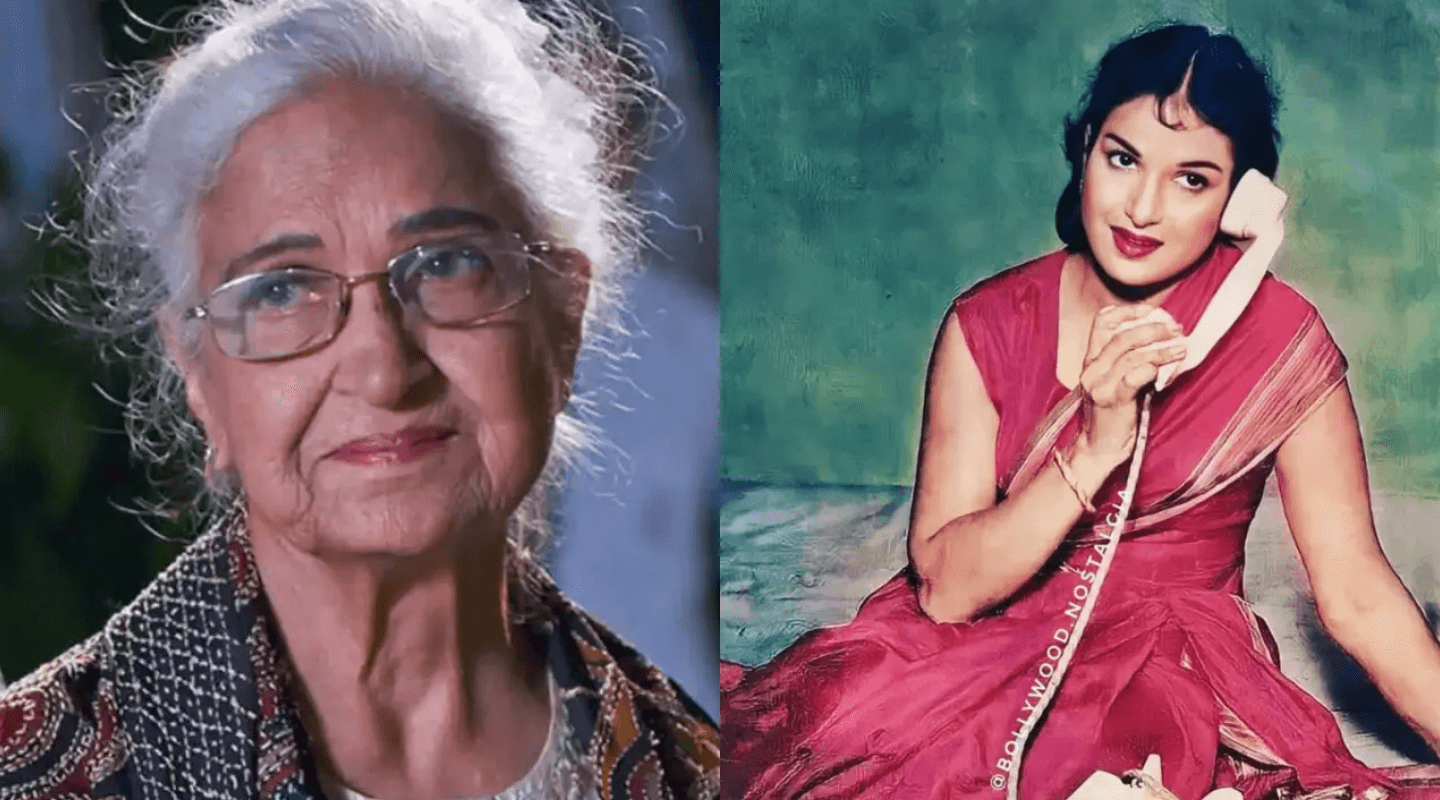
Veteran actress Kamini Kaushal, one of the last surviving legends from Hindi cinema’s golden era, passed away peacefully at her Mumbai residence on November 14, 2025, at the age of 98, closing a remarkable chapter that witnessed seven decades of cinematic history from 1946 to 2022. Born Uma Kashyap on February 24, 1927, in Lahore to Prof. Shiv Ram Kashyap (the “father of Indian Botany”) and educationally accomplished with a B.A. in English Literature from Kinnaird College, Kaushal pioneered a career trajectory unlike her contemporaries, becoming an early educated leading actress in an industry where formal education remained uncommon. Her debut in Chetan Anand’s Neecha Nagar (1946)—which won the Palme d’Or at the inaugural Cannes Film Festival—marked the beginning of an unparalleled journey encompassing over 100 films across multiple decades, including iconic pairings with cinema legends Dilip Kumar (Shaheed, Nadiya Ke Paar, Arzoo), Raj Kapoor, Dev Anand, Ashok Kumar, and later mainstream stars including Rajesh Khanna, Sanjeev Kumar, Manoj Kumar, and contemporary actors Shahid Kapoor (Kabir Singh, 2019) and Aamir Khan (Laal Singh Chaddha, 2022). Her legacy encompasses both lead heroine roles (1946-1963) where her screen credits appeared before male stars’ names—a rarity indicating her prominence—and powerful character performances spanning the 1960s through 2020s, earning her the Filmfare Best Actress Award for Biraj Bahu (1954), Screen Award for Best Supporting Actress (Kabir Singh), Filmfare Lifetime Achievement Award (2015), and universal critical recognition as among the finest actresses in Hindi cinema history.
Early Life: Education and Background
Birth and Family: Born Uma Kashyap on February 24, 1927, in Lahore (then-British India, now Pakistan), Kamini Kaushal entered the world surrounded by intellectual distinction. Her father, Prof. Shiv Ram Kashyap, achieved legendary status as the “father of Indian Botany,” establishing botanical research foundations that would benefit the nation for generations. Her family environment prioritized education and intellectual pursuit over entertainment careers, making her eventual entry into cinema a deliberate personal choice rather than family legacy.
Educational Achievement: In an era when leading film actresses typically entered the industry with minimal formal education, Kamini completed a B.A. in English Literature from Kinnaird College (Lahore), an institution known for rigorous academic standards. This educational background distinguished her as among the first well-educated leading ladies in Hindi cinema, setting her apart from contemporaries and contributing to the intellectual depth evident in her performance choices throughout her career.
Bollywood Journey: The Golden Era Unfolds
Historic Debut (1946): Kamini Kaushal’s entry into cinema came through director Chetan Anand’s Neecha Nagar (1946), a socially conscious narrative that explored themes of class disparity and human dignity. The film achieved unprecedented global recognition by winning the Grand Prix at the inaugural Cannes Film Festival—later renamed the Palme d’Or—making it the first Indian film to receive such international honors. Her performance in this landmark film introduced audiences to a new style of acting: naturalistic, emotionally grounded, and deeply human rather than theatrical or exaggerated. The global attention on Neecha Nagar immediately positioned her among India’s finest performers.
The 1940s-1950s: Leading Lady Era: Throughout the late 1940s and 1950s, Kamini became one of the most sought-after leading heroines in Hindi cinema. Her screen presence was marked by quiet elegance, psychological depth, and the ability to convey complex emotions through subtle expressions. During this period, her name often appeared first in film credits—ahead of her male co-stars—an extraordinary rarity indicating her commercial prominence and artistic significance.
Iconic Pairings with Dilip Kumar: Kamini achieved particular fame through her on-screen chemistry with Dilip Kumar, one of Hindi cinema’s greatest actors. Their collaborations in Shaheed (1948), Nadiya Ke Paar (1948), Pugree, Shabnam (1949), and Arzoo (1950) became box office triumphs and cultural touchstones. These films established her as a leading actress capable of matching Kumar’s intensity while bringing her own distinctive emotional vulnerability to their on-screen relationships.
Other Notable Collaborations: Kamini’s versatility appeared across pairings with cinema’s greatest stars. With Dev Anand, she starred in Ziddi (1948)—Dev’s very first commercial success—and Namoona. With Raj Kapoor, she appeared in his directorial debut Aag (1948) alongside Nargis and Nigar. Her collaborations with Ashok Kumar included Poonam and Night Club, where she functioned as both actress and producer, unusual for the era. She appeared with Sanjeev Kumar in Anhonee (1973), delivering a particularly memorable performance as a cunning antagonist.
Notable Films and Performances
Career-Defining Roles (Lead Heroine): Do Bhai (1947), Shaheed (1948), Nadiya Ke Paar (1948), Ziddi (1948), Shabnam (1949), Paras (1949), Namoona (1949), Arzoo (1950), Jhanjar (1953), Biraj Bahu (1954), Aabroo (1956), Bade Sarkar (1957), Jailor (1958), Night Club (1958), Godaan (1963)
Biraj Bahu (1954) – Breakthrough Performance: Perhaps her most celebrated performance came in Biraj Bahu, a tragic drama where she portrayed the titular character with such emotional depth and nuance that audiences and critics alike recognized her mastery. This role earned her the Filmfare Best Actress Award in 1956, establishing her as an award-winning performer at the pinnacle of her creative powers.
Godaan (1963) – Final Leading Role: Godaan marked her last major performance as a leading heroine. Director Trilok Jetley reportedly held production to accommodate her pregnancy with her second child, unwilling to lose her voice’s distinctive softness. Notably, Pandit Ravi Shankar composed scores for both her first film (Neecha Nagar, 1946) and her final leading role (Godaan, 1963)—a poetic bookending of her heroine era.
Transition to Character Roles: Career Renaissance
In 1965, Kamini made a deliberate career transition from leading heroine to character roles, a move that paradoxically revitalized her career rather than limiting it. Unlike many actresses who faced retirement or obscurity following this transition, Kamini’s powerful performances in character roles—particularly as strong mother figures, wise grandmothers, and complex antagonists—proved she possessed skills extending far beyond romantic leads.
Notable Character Roles: She appeared as mother figures to Rajesh Khanna in Prem Nagar (1974) and Maha Chor (1976), bringing grace and complex emotions to these relationships. She became a fixture in seven Manoj Kumar films—Shaheed (1965), Upkar, Purab Aur Paschim, Sanyasi, Shor, Roti Kapda Aur Makaan, Dus Numbari, and Santosh (1989)—establishing herself as Manoj Kumar’s preferred onscreen mother and confidante.
Television Work: Kamini expanded into television, starring in Doordarshan’s beloved show Chand Sitare and later in StarPlus’s Shanno Ki Shaadi, where she played grandmother figure Bebe. Her television work reached millions, establishing her as a beloved presence across multiple entertainment mediums.
Modern Era Appearances: Living Legacy
Contemporary Films: Even as she approached 90 years old, Kamini continued accepting selective roles in mainstream commercial cinema. She appeared as Shah Rukh Khan’s grandmother in Rohit Shetty’s Chennai Express (2013)—a film that became a box office success. When asked why she accepted the role, she enthusiastically replied: “I just couldn’t say no to working with Shah Rukh Khan!”
Kabir Singh (2019): Her performance as Shahid Kapoor’s understanding grandmother in Kabir Singh earned her a Screen Award for Best Supporting Actress and a Filmfare Award nomination, proving that her acting prowess remained undiminished. Critics praised her ability to convey emotional wisdom and quiet strength in limited screen time.
Final Appearance: Kamini’s last film appearance came with a cameo in Aamir Khan and Kareena Kapoor’s Laal Singh Chaddha (2022), a touching farewell that symbolically closed seven decades of continuous cinema work.
Personal Life and Rare Private Nature
Dignified Distance from Spotlight: Throughout her seven-decade career, Kamini famously maintained a dignified distance from celebrity culture, avoiding tabloid headlines, industry gossip, and public disputes. She granted few interviews, participated sparingly in premieres or award ceremonies, and allowed her work to speak for itself. This quiet professionalism defined her approach to stardom—focusing entirely on craft rather than celebrity persona maintenance.
Low-Profile Family: Her family remained exceptionally private throughout her lifetime. When her passing was announced, a close family associate stated: “Kamini Kaushal’s family is extremely low profile, and needs privacy.” This request honored her lifelong preferences for discretion and respect over public spectacle.
Awards and Recognition
Filmfare Award for Best Actress: Biraj Bahu (1954) [awarded 1956]
Screen Award for Best Supporting Actress: Kabir Singh (2019)
Filmfare Lifetime Achievement Award (2015): Honoring her seven decades of contributions to cinema
Cannes Film Festival Recognition: Global prestige through Neecha Nagar‘s Palme d’Or victory (1946)
Legacy: An Irreplaceable Loss
Kamini Kaushal’s passing on November 14, 2025, represents the loss of the last direct link to cinema’s formative era. Her death closes a narrative arc beginning in 1946—when Indian cinema took its first confident steps toward artistic and technical mastery—through 2022, witnessing the complete evolution from black-and-white cinema to digital streaming platforms.
Her legacy transcends box office collections or awards. Kamini Kaushal pioneered the notion that actresses could maintain intellectual and artistic integrity while building thriving careers. She demonstrated that education enhanced rather than hindered cinematic performance, that marriage and motherhood need not terminate professional ambitions, and that quiet excellence carries more weight than celebrity spectacle. She appears in over 100 films—a filmography that spans multiple eras of cinema, working with legendary directors and actors who defined Hindi cinema’s golden age. Her performances established benchmarks for naturalistic, emotionally intelligent acting that influenced generations of actresses who followed.
At 98 years old, she would have celebrated her 99th birthday in February 2026. She completed a full life witnessing profound transformations: from colonial India to independent nation, from silent films to talking pictures to digital cinema, from women’s severely restricted roles to contemporary gender equality aspirations. Through it all, Kamini Kaushal remained graceful, dignified, and committed to her craft. Her absence leaves Hindi cinema and global cinema forever diminished.
