
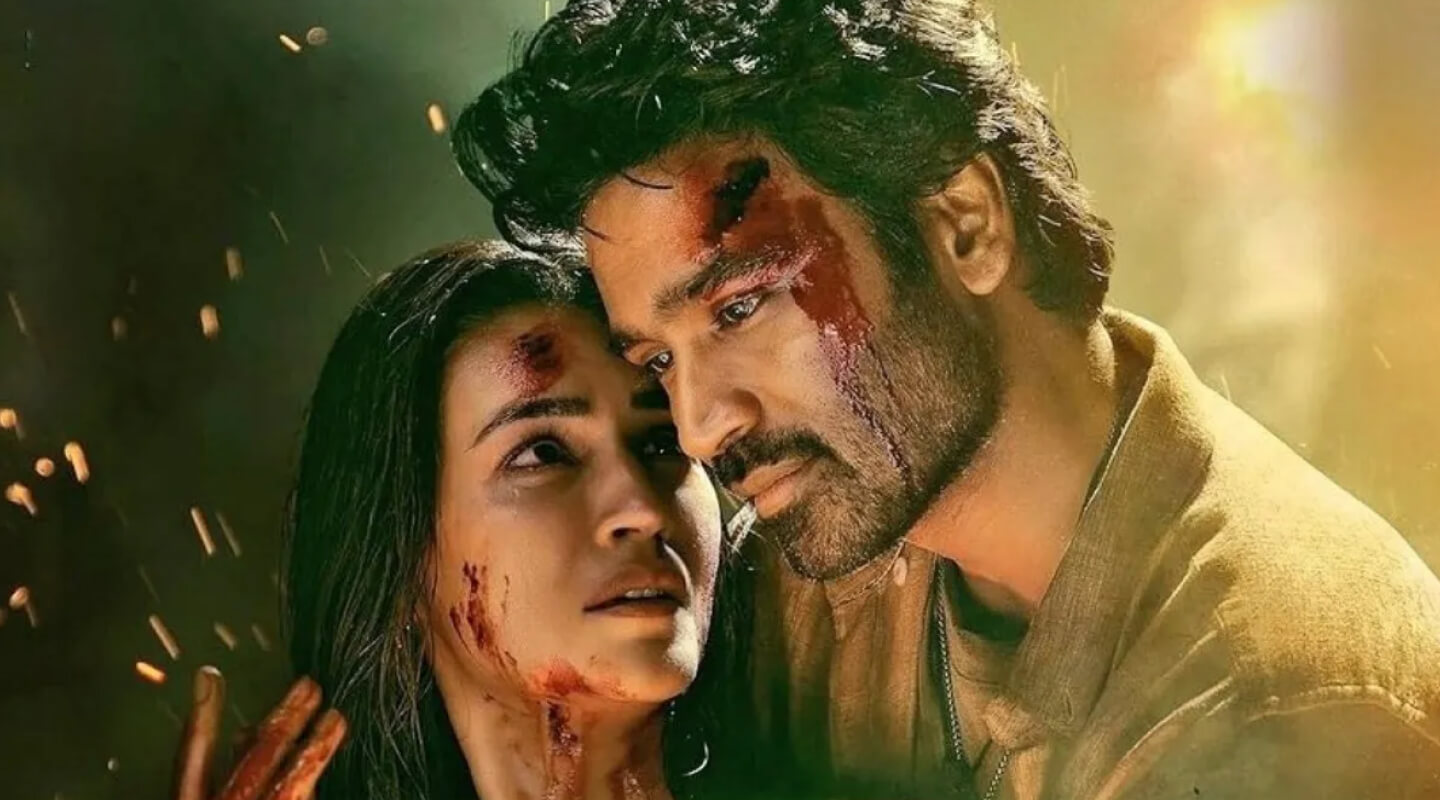
Tere Ishq Mein (2025) is a Hindi romantic drama directed by Aanand L. Rai, reuniting him with Dhanush for another passionate small-town love story filled with obsession and heartbreak. While the film struggles with a messy screenplay and a stretched second half, critics say its powerful performances, emotional intensity, and soulful music keep audiences invested throughout.
Cast, Director & Story Setup
Directed by Aanand L. Rai and written by longtime collaborator Himanshu Sharma with Neeraj Yadav, Tere Ishk Mein follows Flight Lieutenant Shankar Gurukkal, an Air Force pilot grounded for disobedience, whose evaluation by psychologist Mukti Beniwal forces him to confront the memories of their past relationship. The film shifts between his present‑day sessions and a college‑era love story in Delhi University, where an impulsive, aggressive Shankar falls obsessively in love with Mukti and pushes their romance beyond every reasonable limit.
The primary cast features Dhanush as Shankar, Kriti Sanon as Mukti Beniwal, Prakash Raj as Shankar’s stern father Raghav Gurukkal, Priyanshu Painyuli as best friend Ved, Tota Roy Chowdhury as Mukti’s politician father Yashwant Beniwal, and Ravi Kishan as local strongman Sahib. AR Rahman’s music underlines the film’s heightened emotions, with several reviewers noting how the background score and songs effectively intensify both romance and tragedy.[
Reviews & Ratings
Most mainstream critics land Tere Ishk Mein in the “good but flawed” zone, with ratings clustering around 3/5. India Today gives it about 2.5–3 stars, calling it an ambitious attempt to portray toxic, obsessive love that works in intense stretches but struggles with tone and pacing. Hindustan Times rates it 3/5, describing it as a turbulent, uneven romance that is elevated by Dhanush and Kriti Sanon, with a climax that echoes Raanjhanaa and lands with real emotional force even if the road to get there is bumpy.
Bollywood Hungama also awards 3/5, calling it “an intense love saga backed by memorable dramatic moments and strong performances,” but notes that an overlong runtime and a weaker second half limit impact, especially after a gripping first half. Hindi outlets like Navbharat Times praise the front half’s college politics, mad love, and family drama, while pointing out that the narrative starts to scatter after the interval and becomes filmi by the climax, even as Dhanush’s performance holds everything together.
Audience Reactions & Public Buzz
Early user scores on IMDb and Rotten Tomatoes sit in the above‑average bracket, with many viewers calling it “one of the strongest love stories Bollywood has told in years” purely on the strength of its central performances. One highly‑rated IMDb user review describes the film as a “beautifully intense experience from start to finish” where the emotions feel “powerful and unfiltered” and Dhanush and Kriti’s work makes you forget you’re watching a film.
Public review videos outside cinemas echo the same split: many praise the chemistry, music, and emotional punch, while some complain that the second half feels repetitive and occasionally glorifies toxic behaviour. Trade commentators note that word of mouth labels it a “paisa vasool emotional romantic story” for fans of high‑intensity love sagas but not necessarily a universally appealing crowd‑pleaser.
Performances: Dhanush & Kriti Lead the Storm
Across almost every review, Dhanush is unanimously singled out as the film’s biggest strength; critics call him “terrific,” “a trump card,” and “the reason the climax hits as hard as it does.” He plays Shankar as abrasive and impulsive but deeply vulnerable, shifting between violent outbursts, childlike neediness, and hopeless devotion in a way that feels lived‑in rather than showy, and several critics emphasize that he is not simply repeating his Raanjhanaa character.
Kriti Sanon matches him with one of her most layered performances, bringing both fire and fragility to Mukti, a woman trying to reform the man she loves while wrestling with her own ambition and family pressure. Reviews note that she “lights up the screen” and brings real weight to a character that could easily have felt underwritten, cementing her growing reputation after recent projects like Do Patti. Supporting turns by Prakash Raj, Priyanshu Painyuli, Tota Roy Chowdhury and Ravi Kishan are widely described as “solid” and “reliably impactful.”
Aanand L. Rai’s Direction & Box Office Outlook
Tere Ishk Mein continues Aanand L. Rai’s fascination with flawed, obsessive lovers and North Indian social milieus, drawing explicit comparisons to his earlier collaboration with Dhanush in Raanjhanaa. Critics say he stages several knockout sequences—especially the college unrest portions and the emotionally charged finale—but also argue that the film tries to cram in too many ideas, leading to uneven pacing and an overstuffed second half.
Early trade chatter pegs Tere Ishk Mein as a mid‑range theatrical performer: it’s expected to open in double digits and lean heavily on urban centres and Dhanush‑Kriti fandom rather than becoming a pan‑India blockbuster. With strong music, heavy repeat‑value scenes for romance lovers, and a “future cult classic” label from some early reviewers, the film looks positioned for decent legs rather than record‑shattering box office, especially if word of mouth continues to highlight its emotional impact despite structural flaws.
