
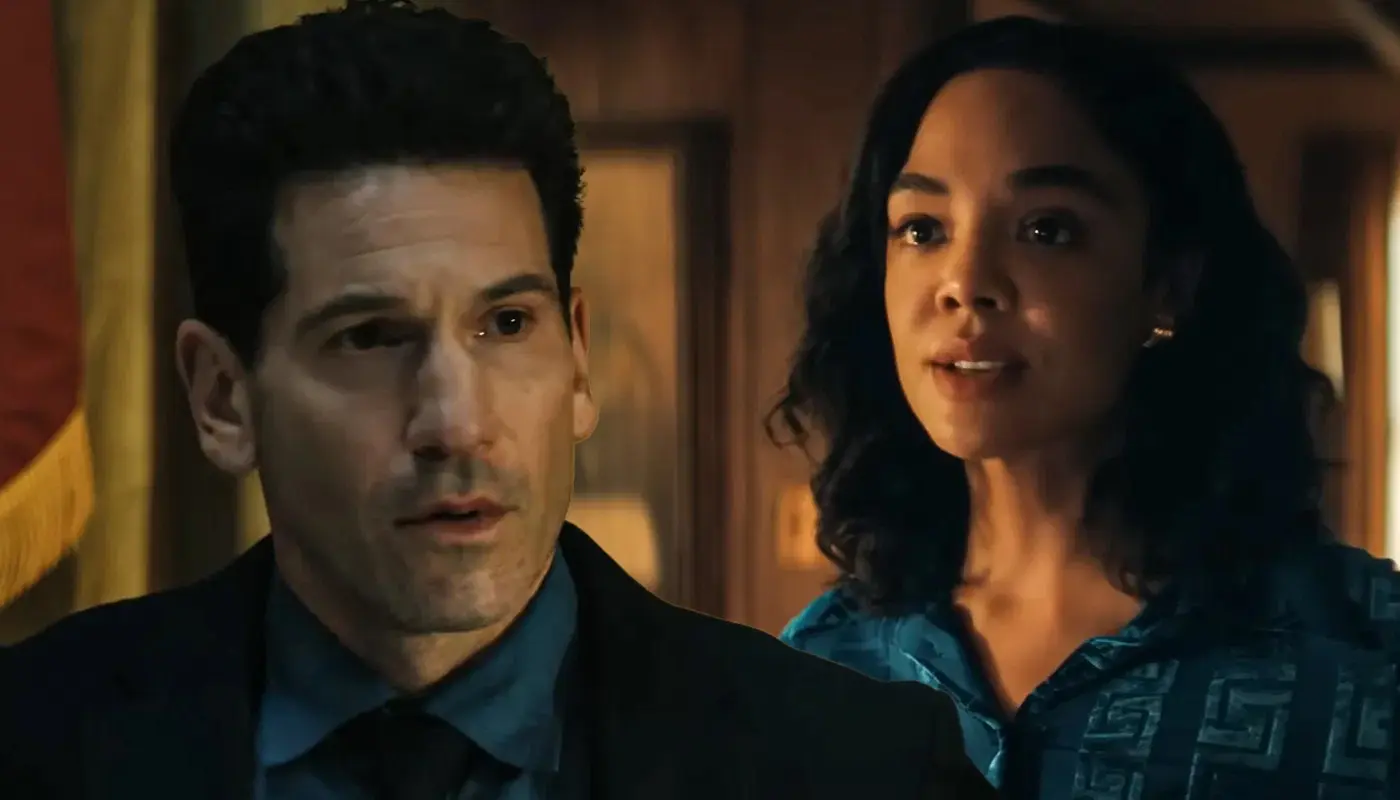
His & Hers, Netflix’s new limited series starring Tessa Thompson and Jon Bernthal, is a crackling psychological thriller that transforms a familiar murder mystery into something far more haunting: a meditation on grief, marriage, motherhood, and the lengths parents will go to protect their children. Based on Alice Feeney’s bestselling novel and directed by William Oldroyd, this six-episode limited series premieres January 8, 2026, and proves that when two of television’s most compelling actors collide on screen, even a twisty whodunnit becomes unmissable.
Thompson & Bernthal’s Crackling Chemistry Elevates a Murder Mystery Into Unexpected Heartbreak
The opening image of His & Hers presents a cautionary tale: cicadas buzz relentlessly in the Georgia heat, a sonic reminder that nature doesn’t care about human suffering—it just keeps on living. This Southern gothic aesthetic sets the tone perfectly for what unfolds: Anna (Thompson), a once-successful Atlanta news anchor who vanished a year ago to escape the grief of losing her young daughter, has returned as a shell of her former self. She’s haunted, isolated, and living in her mother’s house until the universe—or fate—offers her an escape route: a murder in her hometown of Dahlonega that she can investigate as a field reporter.
The “him” to Anna’s “her” is Detective Jack Harper (Bernthal), a small-town cop drowning in secrets of his own—most crucially, he was having an affair with the victim, Rachel Hopkins, and was with her the night she died, stabbed and left in the woods. When Anna shows up at the crime scene demanding answers as a journalist, the two lock eyes with the weight of a fractured marriage, mutual betrayal, and a year of unprocessed grief hanging between them. Their reunion is awkward, loaded, and utterly magnetic.
What makes His & Hers work where so many Netflix murder mysteries fail is the commitment both actors bring to their roles, transforming what could be a standard procedural into an examination of people coming apart at the seams. Thompson is all quiet strength and controlled fury—she projects vulnerability and ambition simultaneously, a woman desperate to prove herself professionally while secretly falling apart emotionally. Every scene she commands feels weighted with her character’s internal architecture: years of career disappointment, motherhood loss, and the crumbling infrastructure of a marriage that couldn’t survive tragedy.
Bernthal, meanwhile, brings an unraveling desperation to Jack—a man teetering on the edge of a complete moral collapse. His Southern accent, subtle and precise, grounds him in this small-town Georgia world where everyone knows everyone and secrets corrode from the inside out. What’s remarkable is how Bernthal balances Jack’s frantic guilt (he makes increasingly ridiculous decisions to hide his involvement, from swabbing his niece’s DNA instead of his own to shouting down his investigation partner Priya whenever she asks logical questions) with moments of genuine tenderness and vulnerability. Jack isn’t just a cop unraveling; he’s a man desperate to hold onto the only good thing left in his life—the possibility of reconciliation with his wife.
The central mystery itself is laid out early: Who killed Rachel Hopkins? The answer arrives in a fairly standard fashion, but the show wisely recognizes that this isn’t really what the story is about. The real mystery—and the real horror—reveals itself in the finale, where the show pivots from “murder whodunnit” to something far darker and far more psychologically complex. Anna’s mother, Alice (Crystal Fox), sends a letter explaining that she, not the obvious suspect, murdered not just Rachel but two other women, all in an act of vengeance rooted in Anna’s own trauma as a teenager.
The twist—that a mother would kill to protect her daughter’s dignity and punish those who stood by while she suffered—is simultaneously grotesque and oddly humanizing. Alice’s letter reads like a dark manifesto on motherhood: “Killing Rachel brought you home. Killing Helen kept you here. Killing Zoe gave you the family you lost.” It’s a macabre meditation on how parents sometimes lose themselves in their children’s pain, how grief can warp into something toxic and murderous.
This emotional revelation transforms the entire viewing experience retroactively—suddenly, scenes you thought were about suspicion become about vulnerability; moments of conflict become moments of people clawing back toward each other through a minefield of lies and secrets. By the finale, Anna and Jack are genuinely trying to rebuild, and they succeed: we flash forward a year to find them reunited, her pregnant, him playing stepfather to his orphaned niece, her having landed her dream job. It’s almost heartbreakingly tender until the final rug-pull reveals that the true killer was Anna’s mother all along—a woman she loved, a woman she forgave without knowing the terrible cost of that forgiveness.
The show doesn’t reinvent the murder mystery genre—procedurally, it has its stumbles. Priya, the sensible investigation partner, seems like the only cop doing actual police work while Jack and Anna bungle their way through town accusing each other and hiding evidence. The show can be soapy in the worst ways, and some of the final twists land with the bluntness of a sledgehammer rather than the precision of a scalpel.
But what His & Hers does remarkably well is use the mechanics of a thriller to get at something true about human nature: how we lie to protect ourselves, how we fail the people we love most, and how sometimes forgiveness can feel like salvation even when it’s really just another kind of blindness. Thompson and Bernthal don’t just solve a murder together—they excavate a marriage from the ruins of grief, and that journey feels earned and devastating in equal measure.
His & Hers is peak comfort binge-watching for people who want their entertainment to crackle with emotional weight and moral complexity alongside the murder mystery mechanics. Stream it all at once—the story demands it—and prepare to have questions about trust, love, and parenthood haunting you long after the credits roll.
