
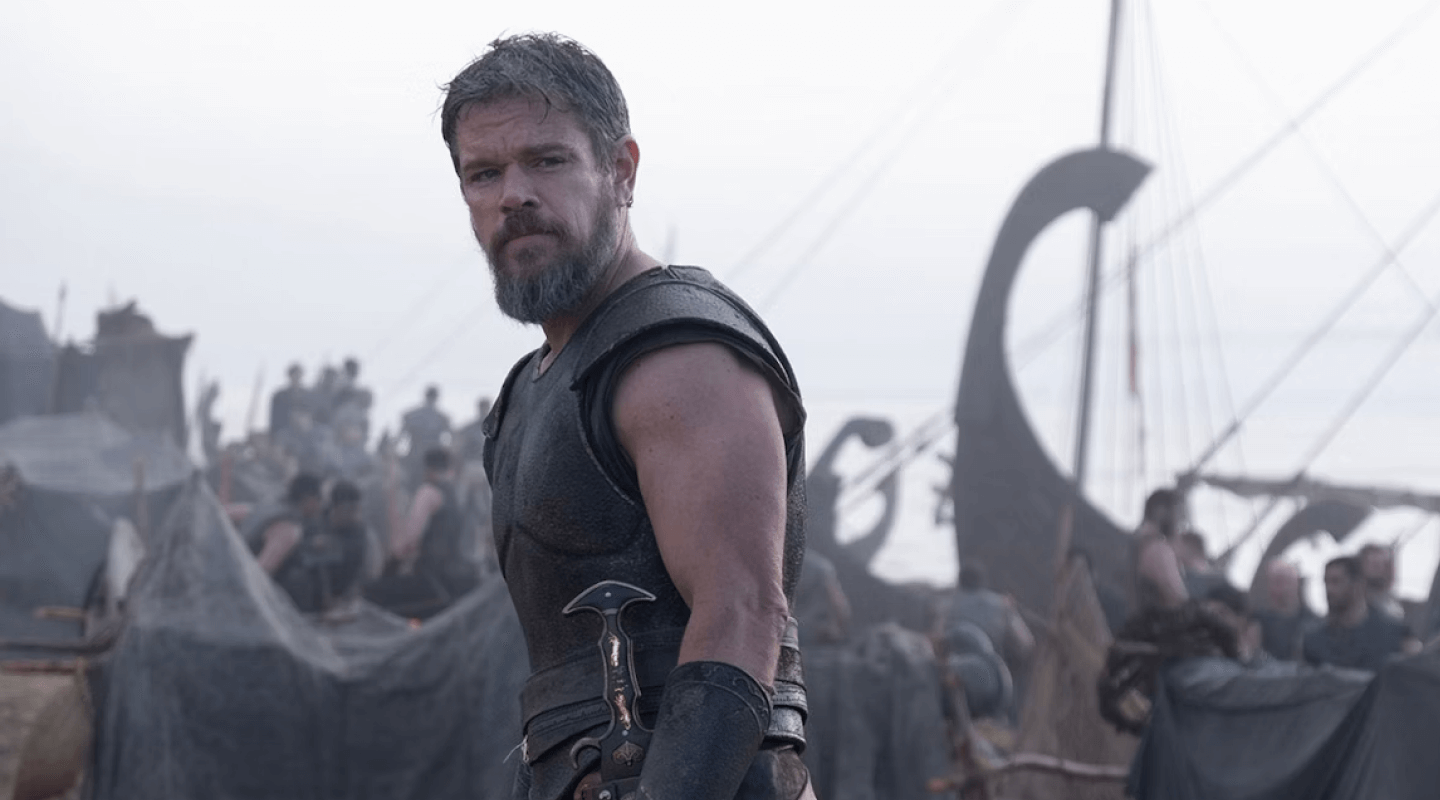
Christopher Nolan’s The Odyssey has unveiled spectacular first-look images revealing the director’s unprecedented commitment to practical effects, including a massive physical Trojan Horse prop constructed on Mediterranean beaches, a 6×6-meter mechanical puppet of Polyphemus the Cyclops designed for filming at Nestor’s Cave in Greece, and authentic ancient Greek vessels sailing real Mediterranean waters—all captured using newly developed IMAX 70mm film cameras shooting the $250 million epic entirely without digital cinematography. Matt Damon leads the star-studded ensemble as Odysseus in his iconic red-plumed Corinthian helmet, joined by Tom Holland as Telemachus, Anne Hathaway as Penelope, Zendaya as Athena, Charlize Theron as Circe, Lupita Nyong’o as Calypso, Robert Pattinson as Hermes, and an A-list supporting cast including Jon Bernthal, Mia Goth, Elliot Page, Benny Safdie, and John Leguizamo in Nolan’s adaptation of Homer’s 8th-century BCE epic poem. Production wrapped in August 2025 after six months of filming across Morocco, Greece, Sicily, Malta, Scotland, Iceland, Western Sahara, and Los Angeles, with supervising art director Samantha Englender confirming the completion of Nolan’s most ambitious undertaking yet. Scheduled for worldwide theatrical and IMAX release on July 17, 2026, through Universal Pictures, early IMAX 70mm tickets sold out within 24 hours with resale pairs reaching over $1,000, suggesting The Odyssey may replicate or exceed Oppenheimer‘s cultural phenomenon status.
Practical Effects: Nolan’s Commitment to In-Camera Filmmaking
Christopher Nolan has doubled down on his career-long commitment to practical effects for The Odyssey, refusing to rely on CGI for the epic’s mythological creatures, ancient architecture, and Mediterranean naval sequences. Matt Damon described seeing the massive physical Trojan Horse prop constructed on a beach as “just so cool,” emphasizing Nolan’s dedication to tangible, in-camera spectacle over digital post-production wizardry.
The Cyclops Polyphemus: Reports confirm that a 6×6-meter mechanical anthropomorphic puppet of Polyphemus the Cyclops has been constructed for filming at Nestor’s Cave in Greece, representing one of the film’s most ambitious practical effects achievements. Rather than creating the iconic one-eyed giant through digital effects, Nolan commissioned handcrafted puppetry to enhance the film’s tactile realism and authenticity.
Authentic Ancient Vessels: First-look set photos reveal Nolan filming authentic ancient Greek vessels sailing actual Mediterranean waters, with crew members expressing astonishment that the director constructed historically accurate boats and filmed on the open sea without visual effects assistance. Reddit users noted: “Nolan is actually out on a boat that accurately represents historical design, sailing on the open sea, and this is all done without any visual effects.”
Physical Sets and Location Shooting: Rather than constructing digital environments, Nolan filmed across eight countries spanning three continents, utilizing real Mediterranean islands, Moroccan deserts, Scottish highlands, and Icelandic landscapes to create the epic’s diverse mythological geography.
IMAX 70mm Innovation: First Film Shot Entirely with New Cameras
The Odyssey represents the first Christopher Nolan film shot entirely using IMAX 70mm film cameras, employing a newly developed lighter and quieter version alongside existing IMAX technology. Over 2 million feet (610 kilometers) of IMAX 70mm film was used during the six-month production—an unprecedented quantity reflecting the epic’s enormous scope and Nolan’s commitment to capturing every frame at maximum resolution.
Cinematographer Hoyte van Hoytema reunited with Nolan for their sixth collaboration, following Interstellar, Dunkirk, Tenet, and Oppenheimer. The IMAX format allows unprecedented visual clarity for the film’s mythological creatures, naval battles, Mediterranean vistas, and intimate character moments, positioning The Odyssey as a visual spectacle demanding theatrical viewing.
Cast: A-List Ensemble Bringing Homer to Life
Matt Damon as Odysseus (Lead): Damon leads the ensemble as the legendary Greek king of Ithaca, marking his third collaboration with Nolan following Interstellar and Oppenheimer. Nolan described Odysseus as “complicated, an amazing strategist, and a very wily person,” emphasizing interest in the character’s cleverness and inventiveness. First-look images show Damon in full costume donning an iconic red-plumed Corinthian helmet.
Tom Holland as Telemachus: Holland portrays Odysseus’s determined son searching for his long-lost father, bringing youthful energy and mainstream appeal to the epic’s emotional core.
Anne Hathaway as Penelope: Hathaway reunites with Nolan (following Interstellar and The Dark Knight Rises) as Penelope, Odysseus’s faithful wife defending Ithaca against suitors during his 10-year absence.
Divine and Mythological Characters:
– Zendaya as Athena (Goddess of wisdom and Odysseus’s divine protector)
– Charlize Theron as Circe (Enchantress who transforms men into animals)
– Lupita Nyong’o as Calypso (Nymph who detains Odysseus on her island for seven years)
– Robert Pattinson as Hermes (Messenger god providing guidance)
Supporting Ensemble: Jon Bernthal, Mia Goth, Benny Safdie, Elliot Page, John Leguizamo, Himesh Patel, Samantha Morton, Corey Hawkins, Bill Irwin, Jesse Garcia, Will Yun Lee, Rafi Gavron, Shiloh Fernandez, and Nick E. Tarabay in undisclosed roles.
Director and Screenwriter: Nolan’s Vision
Director/Writer: Christopher Nolan | Producer: Emma Thomas (Nolan’s wife and longtime producing partner) | Production Company: Syncopy Inc. | Distributor: Universal Pictures
Nolan began writing the screenplay in March 2024 and secured the project at Universal by October 2024. The director and Thomas described The Odyssey as “foundational” by incorporating aspects of different types of stories, with Nolan inspired to elevate his filmography by various Greek mythology works he watched growing up—particularly Ray Harryhausen’s stop-motion fantasy films.
Matt Damon confirmed that Nolan’s adaptation will closely follow Homer’s classic epic poem, stating: “If the text describes fleeing a Cyclops, that is exactly what audiences will see.” The screenplay prioritizes faithfulness to source material while maintaining Nolan’s signature narrative sophistication and structural experimentation.
Production Timeline and Filming Locations
Principal Photography: February 25, 2025 – August 2025 (six months) | Filming Locations: Morocco (Aït Benhaddou, Essaouira, Marrakesh, Ouarzazate), Greece (various islands), Sicily (Favignana Island, Aeolian Islands), Malta, Scotland, Iceland, Western Sahara, Los Angeles | Budget: $250 million (Nolan’s most expensive film)
Production commenced at Morocco’s Aït Benhaddou village depicting the city of Troy, expanding across multiple continents over six months. Supervising art director Samantha Englender confirmed filming wrapped in August 2025 with a behind-the-scenes Instagram post marking the production’s final day.
Post-Production and Technical Team
Visual Effects: DNEG (with Andrew Jackson as visual effects supervisor) | Editor: Jennifer Lame (following Oppenheimer) | Composer: Ludwig Göransson (reuniting after Oppenheimer and Tenet)
While DNEG provides visual effects supervision, Nolan’s commitment to practical filmmaking ensures effects primarily enhance rather than create the film’s spectacle. Göransson’s score promises to match the epic’s mythological grandeur, following his Academy Award-winning work on Oppenheimer.
Release Information and Where to Watch
Theatrical Release Date: July 17, 2026 (worldwide) | Formats: Standard theatrical, IMAX 70mm, Premium Large Format (PLF) | Distributor: Universal Pictures | Runtime: TBA
The Odyssey will premiere exclusively in theaters worldwide on July 17, 2026, with IMAX 70mm presentations representing the optimal viewing format to experience Nolan’s unprecedented visual achievement. Early IMAX 70mm tickets at AMC Lincoln Square in New York sold out within 24 hours, with resale pairs reaching over $1,000—indicating extraordinary audience anticipation potentially exceeding Oppenheimer‘s cultural phenomenon status.
Following typical Nolan theatrical patterns, the film will likely maintain extended theatrical runs (potentially 100+ days) before arriving on streaming platforms and home video.
