
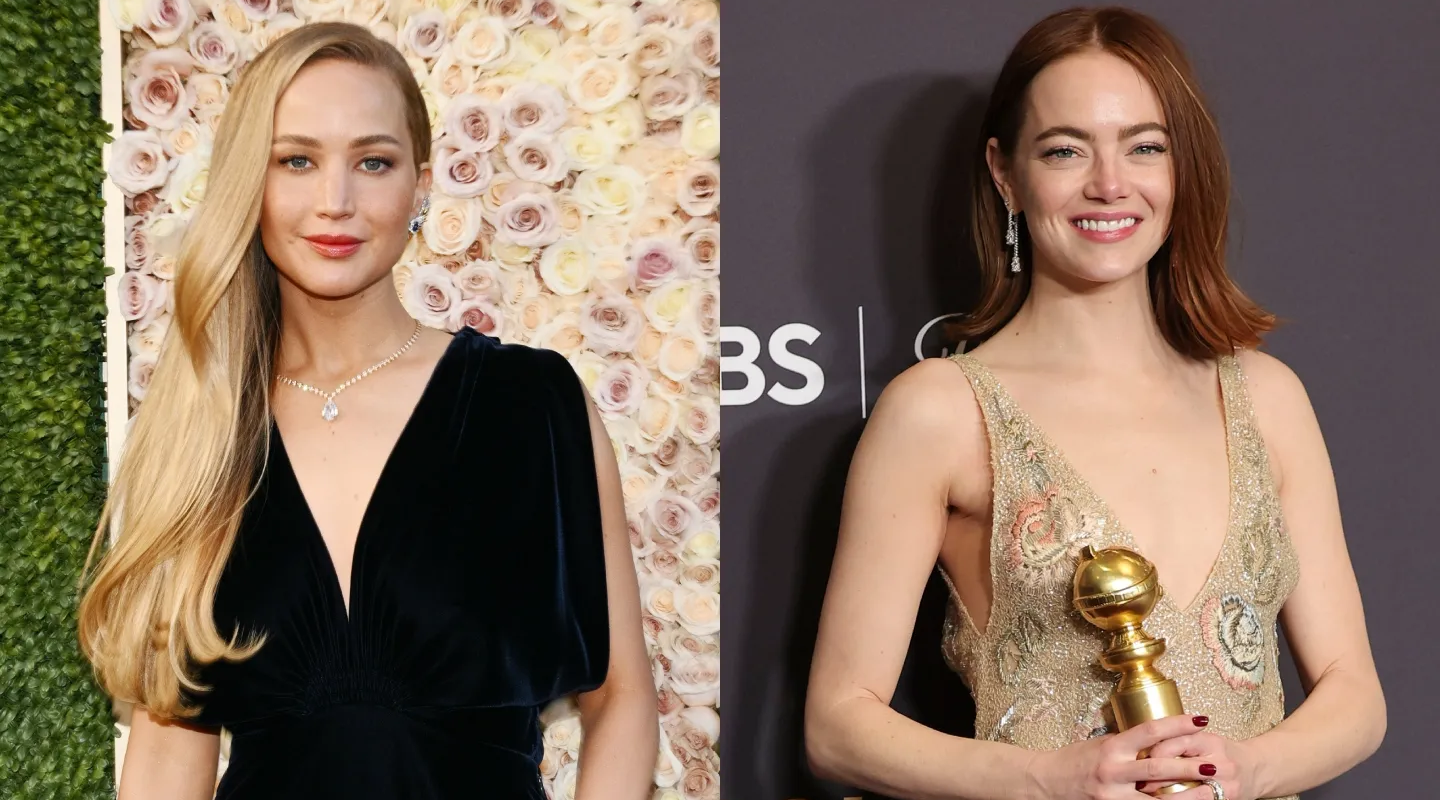
Jennifer Lawrence and Emma Stone are officially collaborating for the first time in their careers through a brand-new Miss Piggy movie, marking one of entertainment’s most surprising and long-overdue reunions between two of contemporary cinema’s most acclaimed actresses. Announced on November 5, 2025, during Lawrence’s guest appearance on the Las Culturistas podcast with Bowen Yang and Matt Rogers, the project represents a historic moment: both the inaugural solo feature film for the legendary Muppet character and the first-ever on-screen collaboration between the two Oscar-winning actresses despite sharing remarkably parallel career trajectories, mutual professional admiration, and decades of friendship. Lawrence revealed that she and Stone are producing the film together, with Tony Award-winning playwright and Oh, Mary! creator Cole Escola attached to pen the screenplay—an unusual creative choice that signals the producers’ commitment to bringing irreverent humor, theatrical sensibility, and compelling character-driven narratives to the Muppets franchise. When podcast hosts asked if Lawrence and Stone would star in the film themselves, Lawrence responded with candor: “I think so. We have to… It’s fucked up [that we haven’t done a movie together]”—an honest acknowledgment that their simultaneous ascent through Hollywood’s hierarchy, A-list status, and shared superstardom has somehow never resulted in on-screen collaboration. The project is currently in early development at Disney and represents a significant strategic move for the studio—transforming Miss Piggy from supporting character within the Muppets ensemble into a central protagonist capable of anchoring a feature film with the combined star power of two of cinema’s most bankable and respected actresses. As both actresses celebrate remarkable recent achievements (Lawrence’s partnership with Robert Pattinson in Die My Love, Stone’s continued prestige project engagement), the Miss Piggy collaboration arrives as their shared statement that cinema’s most iconic friendship deserves cinematic immortalization.
The Historic First Collaboration: 50+ Years Overdue
Announcement Date: November 5, 2025 | Announcement Platform: Las Culturistas podcast with Bowen Yang and Matt Rogers | Development Status: Early stages at Disney | Project Significance: First-ever on-screen collaboration between Lawrence and Stone | Character History: Miss Piggy’s first solo feature film (created 1970s, 50+ years as supporting character)
Jennifer Lawrence’s casual but emotionally resonant podcast announcement represented a watershed moment in contemporary Hollywood: two of cinema’s most acclaimed actresses—despite sharing remarkably parallel career trajectories, mutual professional respect, and decades of documented friendship—are finally collaborating on-screen for the first time. When podcast hosts expressed excitement about the announcement, Lawrence added candor acknowledging the absurdity: “I think so. We have to… It’s fucked up [that we haven’t done a movie together].”
This admission speaks to a peculiar Hollywood phenomenon where two powerhouse actresses with parallel ascents somehow never aligned on a project despite identical access to Hollywood’s most prestigious scripts, directors, and productions. The Miss Piggy project represents both actresses’ determination to finally rectify this decades-long oversight.
Creative Team: Cole Escola and Playwright Sensibility
Screenwriter: Cole Escola | Background: Tony Award winner, playwright | Signature Work: Oh, Mary! (Broadway smash hit) | Television Writing Credits: The Other Two, At Home with Amy Sedaris, Ziwe | Screenwriting Experience: No released feature films (first major screenplay assignment) | Creative Style: Irreverent humor, compelling female character narratives, theatrical sensibility
The selection of Cole Escola as screenwriter represents an unconventional creative choice—the Tony-winning playwright and Oh, Mary! creator has no theatrical release screenwriting credits yet has been entrusted with Miss Piggy’s solo narrative debut. This decision signals that Lawrence and Stone prioritize Escola’s distinctive voice, irreverent humor, and proven ability to craft narratives around compelling female characters over conventional Hollywood screenwriting experience.
Escola’s Broadway success with Oh, Mary!—a play Lawrence herself considered starring in before scheduling complications intervened—provided direct evidence of their creative compatibility. Lawrence revealed during interviews that she originally wanted to play Mary Todd Lincoln in Oh, Mary! but ultimately determined that the “eight shows a week and six weeks of rehearsal” schedule proved incompatible with her responsibilities as a mother of two young children.
Jennifer Lawrence: Career Overview and Current Projects
Age: 35 years old (as of November 2025) | Academy Awards: 1 Oscar (Silver Linings Playbook, 2013) | Breakthrough Role: Katniss Everdeen in The Hunger Games franchise (2012-2015) | Recent Notable Films: No Hard Feelings (2023), Die My Love (2025, releasing November 7) | Upcoming Projects: The Wives (murder mystery inspired by Real Housewives franchise)
Career Trajectory Analysis: Lawrence achieved superstardom through The Hunger Games franchise (2012-2015), establishing herself as Hollywood’s leading action-adventure star capable of anchoring billion-dollar franchises. Her 2013 Oscar win for Silver Linings Playbook validated her dramatic acting capabilities beyond blockbuster spectacle. However, a self-imposed semi-retirement (2015-2019) followed her marriage and family planning decisions.
Die My Love (November 7, 2025): A psychological thriller directed by Lynn Ramsay, featuring Lawrence alongside Robert Pattinson, LaKeith Stanfield, Sissy Spacek, and Nick Nolte. Based on the 2017 novel by Ariana Harwicz, the film tracks Grace’s psychological deterioration as she relocates from New York City to rural Montana with her husband. During interviews, Lawrence joked that she anticipated some audiences might misinterpret the film as “Twilight fan-fic,” adding with characteristic humor: “For those people, I just want to say, ‘Walk, don’t run [to see the movie]. Take your time. It’s poetry.'”
Franchise Philosophy: Lawrence revealed that while she initially avoided franchise commitments to maintain schedule flexibility for her family, she remains open to future franchise participation. She stated: “I enjoy being part of franchises because it’s uncommon in film to collaborate with the same team for years… But I have two young children, so I can’t envision it at the moment. I just need more flexibility in my schedule. But not never.”
Emma Stone: Career Overview and Current Status
Age: 36 years old (as of November 2025) | Academy Awards: 2 Oscars (La La Land 2017, Poor Things 2024) | Breakthrough Role: Olive Penderghast in Easy A (2010) | Recent Notable Films: Poor Things (2024 – BAFTA winner), The Favourite (2018 – BAFTA winner) | Continued Prominence: Consistent engagement with prestige projects, international acclaim
Career Trajectory Analysis: Unlike Lawrence’s episodic career pattern, Stone maintained consistent international prominence across her entire post-breakout career. Her Easy A (2010) breakthrough led to sustained A-list status, with her 2017 Oscar win for La La Land and 2024 Oscar win for Poor Things establishing her as one of contemporary cinema’s most decorated actresses (two Oscars to Lawrence’s one).
Prestige Project Commitment: Stone’s career demonstrates greater investment in prestige filmmaking—collaborating repeatedly with acclaimed directors including Yorgos Lanthimos (The Favourite, Poor Things), Damien Chazelle (La La Land), and others. She has maintained lower profile relative to Lawrence in recent years, prioritizing artistic projects over celebrity activism or public visibility.
Parallel Career Trajectories: Why They Never Worked Together
Career Similarities:
– Both achieved breakout recognition through young adult franchises (Lawrence’s Hunger Games, Stone’s Easy A franchise trajectory possibilities)
– Both won Oscars (Lawrence 1, Stone 2) establishing legitimacy as serious dramatic actresses
– Both navigated Hollywood’s gender dynamics and industry sexism successfully
– Both maintained A-list status for 10+ years despite distinct career arc differences
Why No Previous Collaboration Despite Friendship:
– Professional timing: Lawrence’s Hunger Games commitment (2012-2015) coincided with Stone’s independent prestige filmmaking phase
– Competing industry dynamics: Limited high-profile female-led projects with dual A-list female casts
– Career trajectory differences: Lawrence prioritized motherhood/family (2015-2020); Stone maintained work consistency
– Script availability: Insufficient projects requiring precisely these two actresses simultaneously available
Miss Piggy: Character History and Cultural Impact
Character Creation: Created in 1970s by puppeteers Bonnie Erickson and Frank Oz | First Appearance: 1974 special “Herb Alpert and the TJB” | Character Development: Evolved from background character to central Muppet ensemble figure | Defining Characteristic: Glamorous diva obsessed with Kermit the Frog | Cultural Significance: Iconic female character in major entertainment franchise
Miss Piggy emerged in the 1970s as a groundbreaking character—a female puppet protagonist refusing traditional gender role expectations. Rather than fulfilling service functions within the ensemble, Miss Piggy claimed narrative centrality through sheer personality force, romantic agency, and sophisticated comedic timing. Her repeated romantic pursuit of Kermit (rather than waiting passively) represented progressive female characterization for the era.
Cultural Reach: Miss Piggy achieved recognition beyond entertainment circles—the character warranted royal-level consideration when the Duke of Edinburgh expressed concern about her potentially “crashing” the royal box during the Coronation Concert at Windsor Castle in 2023. The character’s brand recognition transcends generational boundaries, with audiences from the 1970s through contemporary viewers maintaining active affection for the character.
Solo Feature Film Significance: Despite over 50 years of prominence, Miss Piggy has never anchored her own feature film—a remarkable omission given her cultural ubiquity and character complexity. The Lawrence-Stone-Escola collaboration represents her long-overdue opportunity to transition from supporting character to narrative protagonist.
The Muppets: 70th Anniversary and Strategic Reinvestment
The Muppets 70th Anniversary: 2025 celebration of Jim Henson’s enduring franchise | Upcoming Disney+ Special: The Muppet Show reboot featuring guest star Sabrina Carpenter, directed by Seth Rogen’s Point Grey Pictures | Special Release Timeline: 2025 (coinciding with 50th anniversary of original series) | Franchise Status: Disney acquisition (2004), continued strategic reinvestment
The Miss Piggy film arrives within Disney’s broader reinvestment strategy surrounding the Muppets franchise. The announcement of The Muppet Show reboot (with Seth Rogen executive producing and Sabrina Carpenter guest starring) demonstrates Disney’s commitment to modernizing the beloved franchise for contemporary audiences while maintaining franchise legacy and authenticity.
The Miss Piggy project represents the logical culmination of this reinvestment—transforming a 50+ year-old supporting character into a contemporary feature film anchored by two of Hollywood’s most bankable actresses and written by a Tony Award-winning playwright. This strategic combination signals Disney’s determination to prove that beloved ensemble characters warrant solo narrative exploration.
What This Collaboration Means for Hollywood
The Lawrence-Stone-Escola Miss Piggy project represents several significant cultural moments simultaneously: two actresses finally collaborating after decades of parallel prominence; a female ensemble character claiming narrative primacy; unconventional creative partnerships (playwright Escola writing her first major screenplay); and Disney’s strategic embrace of character-driven storytelling over franchise mechanics.
For contemporary Hollywood, this collaboration suggests that friendship and creative synchronicity—rather than traditional industry mechanics—can ultimately drive project development. Lawrence and Stone’s decision to produce together and recruit Escola specifically indicates that these actresses prioritized creative vision over studio convenience, challenging conventional wisdom regarding franchise filmmaking.
As the project moves through development and production, audiences will witness whether Lawrence and Stone’s collaborative instincts—combined with Escola’s theatrical sensibility—can successfully transform a beloved puppet character into a contemporary film narrative of genuine artistic and commercial significance.
