
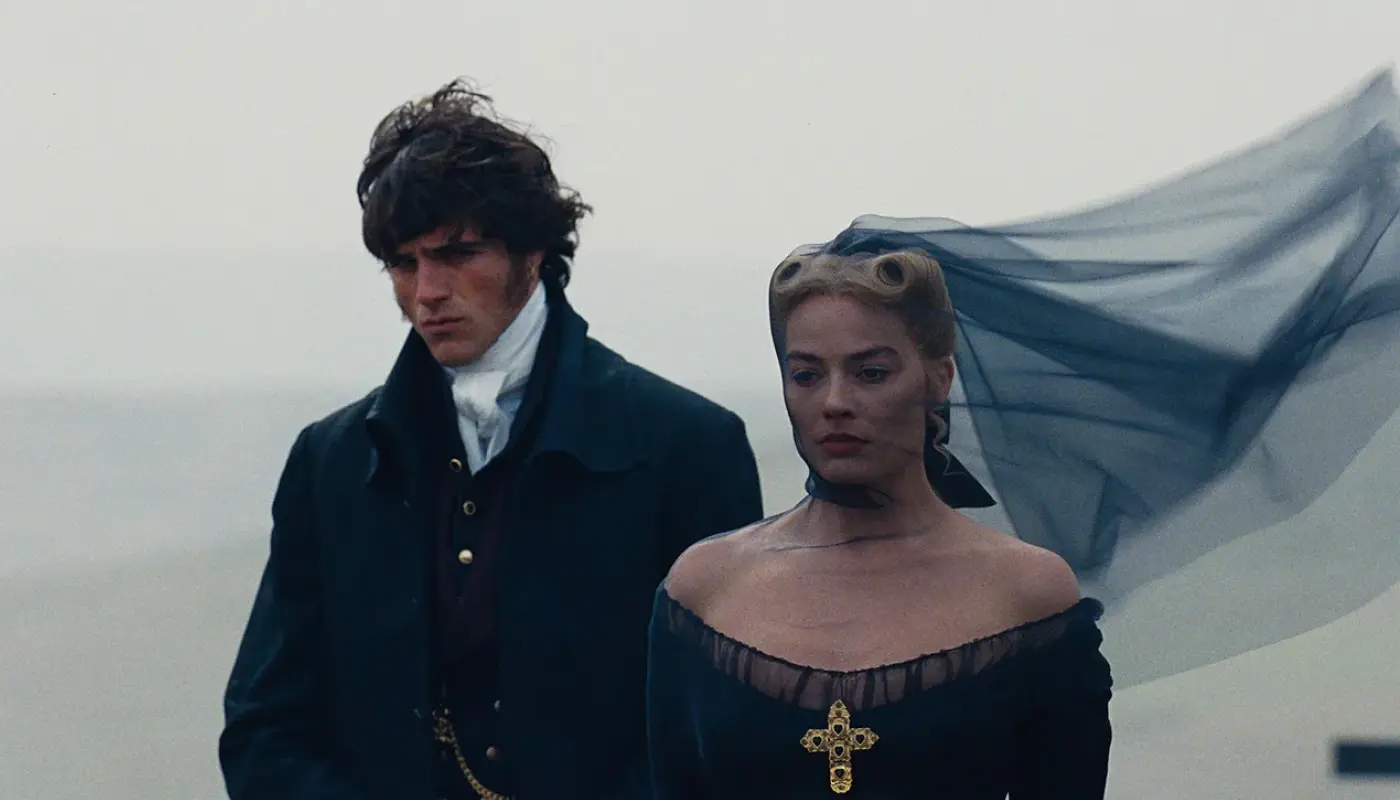
The release of Emerald Fennell’s “Wuthering Heights” (the quotation marks are intentional, a stylistic choice by the director to signal this is a “version” of the truth) has officially set the cinematic world ablaze. Starring Margot Robbie and Jacob Elordi, the film arrived in theaters on February 13, 2026, just in time to dismantle every romantic notion you might have held about Valentine’s Day.
The Vision: Saltburn Meets the Moors
Emerald Fennell has built a reputation on being “unsubtle.” From the candy-coated revenge of Promising Young Woman to the bathtub-slurping audacity of Saltburn, she is a filmmaker who thrives in the space between the beautiful and the repulsive.
With “Wuthering Heights,” she has leaned into what she calls her “teenage interpretation” of the novel. The result is a film that replaces the dense generational trauma of the book with a high-octane exploration of two people who are essentially “beautiful monsters.”
A Stylized World
The production design by Suzie Davies and cinematography by Linus Sandgren (who shot La La Land) transform Yorkshire into a hyper-real landscape. The interiors of the Heights are dark, moody, and minimalist, featuring avant-garde touches like braided hair adorning bed canopies and wall sconces shaped like human hands.
Contrasting this is Thrushcross Grange, the home of the Lintons, which is presented as a sterile, precise “dollhouse.” This visual dichotomy serves as a constant reminder of the class warfare and domestic imprisonment that drives the characters to madness.
The Casting: Robbie and Elordi’s Electric Toxicity
The casting of Margot Robbie and Jacob Elordi was a lightning rod for controversy from the moment it was announced. Critics pointed out that Robbie, in her mid-30s, is significantly older than the teenage Cathy of the novel’s first half. Meanwhile, Elordi’s casting as Heathcliff sparked intense debate regarding the character’s “dark-skinned” and “Lascar” descriptions in the original text.
Robbie delivers a performance that is “wilful, mean, and a recreational sadist.” She doesn’t ask the audience for sympathy; she demands their attention. Her Cathy is a woman trapped by the pragmatism of her era, choosing the stable, wealthy Edgar Linton (Shazad Latif) while her soul remains tethered to the wildness of Heathcliff.
Fresh off his turn as Frankenstein’s creature, Elordi brings a feral, physical intensity to the role. He plays Heathcliff as a man who has been “sanded down” by cruelty until only revenge remains. Whether he is crawling like a loyal dog at Cathy’s feet or looming over the moors with a bearded, Manson-esque grit, he embodies the “toxic king” archetype for a new generation.
The Plot: A Radical Reimagining
Fennell has famously “dropped a bomb” on the narrative structure. Gone is the second half of the book—the story of the next generation (young Cathy and Linton Heathcliff) is entirely excised. Instead, the film focuses on the central triangle: Cathy, Heathcliff, and Edgar.
The Major Changes
Critical Reception: A Love-Hate Affair
| Publication | Sentiment | Key Takeaway |
|---|---|---|
| The Telegraph | 5/5 Stars | Style as substance. A movie that vibrates on its own private frequency. |
| The Guardian | 2/5 Stars | An emotionally hollow, bodice-ripping misfire. A luxurious pose of unserious abandon. |
| USA Today | 3.5/4 Stars | Awfully stunning to look at… toxic obsession and gothic sauciness. | Pajiba | Positive | Robbie and Elordi are beautiful monsters… the best Heathcliff and Cathy we’ve seen. |
Critics like Peter Bradshaw have dismissed it as “camp” and “ersatz-sad,” while others, like Courtney Howard, have hailed it as a “god-tier new classic” that expertly captures the ache of desire.
Why It Matters in 2026
“Wuthering Heights” is the definitive “Event Cinema” of the year. It captures the current cultural fascination with “Female Gaze” and “Toxic Romance” the “I can fix him” energy that dominates modern discourse.
By removing the generational baggage of the novel, Fennell has created a concentrated, explosive look at how two people can destroy each other while claiming to be “one soul.” It is a film that invites you to succumb to its narcotic pull, even as it warns you that there is no happy ending waiting in the mist.
Final Thoughts: Should You See It?
If you want a movie that looks like a Pinterest board brought to life with a side of psychological body horror, then yes. If you are a Brontë purist who values historical accuracy and the nuanced exploration of 19th-century class disparity over original Charli XCX bops… you might want to sit this one out.
