
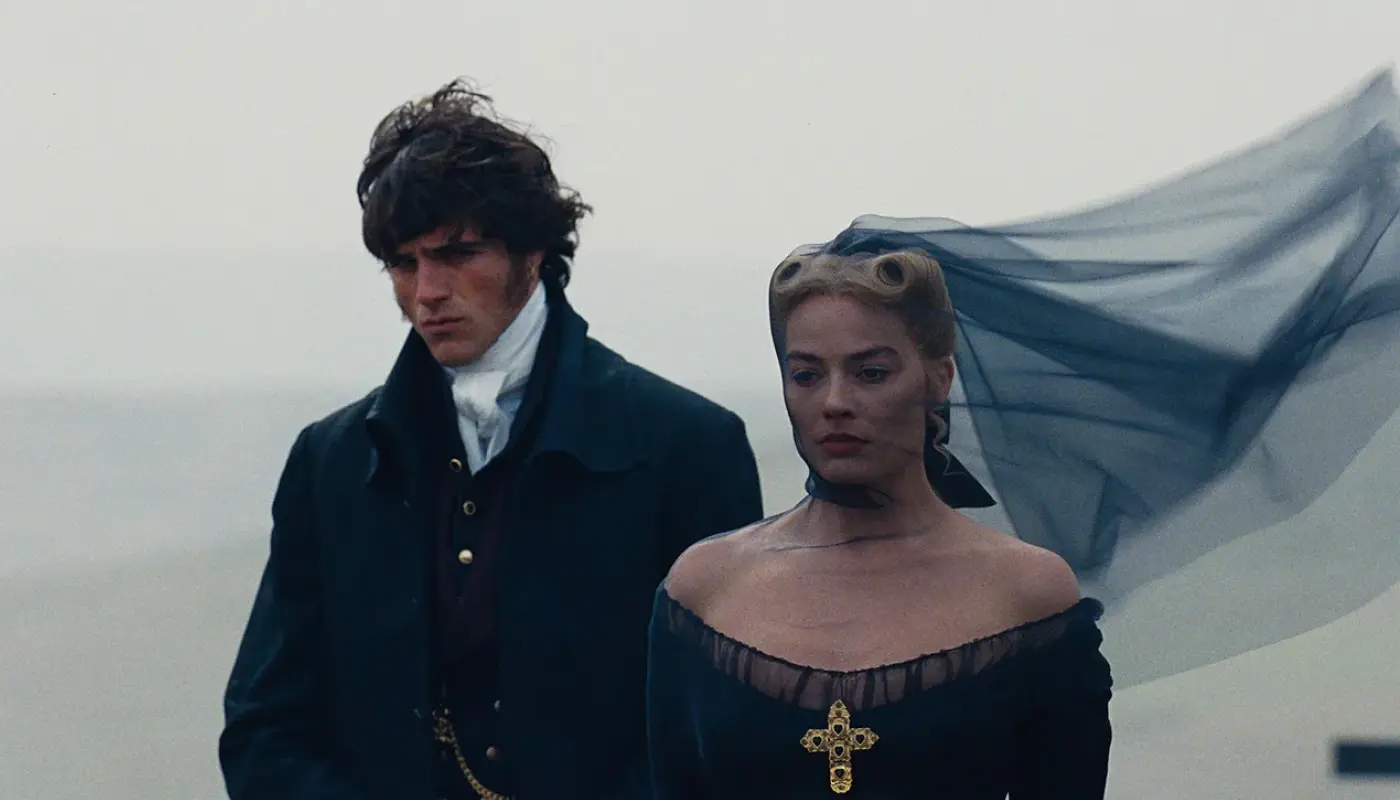
The release of Emerald Fennell’s “Wuthering Heights” (the quotation marks are a deliberate stylistic choice to signal this is a personal “version”) has officially set the cinematic world ablaze. Starring Margot Robbie and Jacob Elordi, the film arrived in theaters on February 13, 2026, just in time to dismantle every traditional romantic notion of Valentine’s Day.
A Bold Reimagining of a Classic
Adapting Wuthering Heights has always been a delicate balancing act. The novel’s nonlinear narrative, unreliable perspectives, and morally complicated characters make it both rich and challenging. This new version streamlines the structure while retaining the emotional core: the obsessive bond between Heathcliff and Catherine Earnshaw.
Rather than leaning heavily into period stiffness, the film embraces atmosphere. Windswept landscapes, brooding skies, and a restrained yet evocative score create a haunting backdrop that mirrors the characters’ emotional chaos. The gothic tone feels immersive rather than theatrical, grounding the drama in something visceral and immediate.
Importantly, this adaptation does not try to modernize the dialogue in a jarring way. Instead, it allows the performances to convey contemporary emotional nuance. That choice pays off.
A Stylized, Anachronistic World
The production design by Suzie Davies and cinematography by Linus Sandgren transform Yorkshire into a hyper-real landscape. The interiors of the Heights are dark, moody, and minimalist, featuring avant-garde touches like wall sconces shaped like human hands and rooms painted to match the shade of the protagonist’s skin.
Contrasting this is Thrushcross Grange, the home of the Lintons, which is presented as a sterile, precise “dollhouse.” This visual dichotomy serves as a constant reminder of the class warfare and domestic imprisonment that drives the characters toward madness.
Margot Robbie as Catherine Earnshaw: Wild, Fragile, Unforgettable
Margot Robbie delivers one of her most layered performances to date. Known for commanding roles that balance vulnerability and ferocity, she brings both qualities to Catherine Earnshaw.
Catherine can be difficult to love. She is impulsive, prideful, and often selfish. Robbie doesn’t attempt to smooth those flaws. Instead, she leans into them, portraying Catherine as a woman torn between social ambition and untamed passion. Her chemistry with Jacob Elordi feels combustible — not in a glossy, romanticized way, but in a way that suggests two souls locked in emotional combat.
What stands out most is Robbie’s ability to communicate Catherine’s inner turmoil without excessive melodrama. A flicker of hesitation, a lingering glance across a windswept field — these quiet moments carry as much weight as the film’s louder confrontations. For viewers familiar with previous adaptations, this Catherine feels more psychologically transparent. We understand her contradictions, even when we don’t agree with her choices.
Jacob Elordi as Heathcliff: Brooding Without Caricature
Heathcliff is one of literature’s most enigmatic antiheroes. Past portrayals have sometimes leaned too far into cold cruelty or romanticized torment. Jacob Elordi strikes a compelling balance.
His Heathcliff begins as a wounded outsider, marked by humiliation and longing. As the story progresses, that longing hardens into resentment and calculated revenge. Elordi resists the temptation to play Heathcliff as a one-note villain. Instead, he imbues him with quiet intelligence and suppressed rage, making his transformation both tragic and inevitable.
There’s a magnetic stillness to his performance. In scenes opposite Robbie, tension simmers even in silence. The emotional push and pull between the two actors becomes the film’s driving force, elevating familiar plot points into moments of genuine suspense.
Rather than glamorizing Heathcliff’s darker impulses, the film frames them as the consequence of emotional neglect and social exclusion — a subtle but meaningful shift.
Chemistry That Feels Dangerous
The success of any Wuthering Heights adaptation hinges on the central relationship. Without believable chemistry, the story collapses under its own melodrama. Fortunately, Robbie and Elordi deliver something rare: a connection that feels both passionate and destructive. Their scenes crackle with emotional volatility. Arguments feel raw rather than theatrical, and tender moments are tinged with inevitability — as though both characters know happiness cannot last.
The film wisely avoids turning their love into a glossy fairy tale. Instead, it highlights how obsession can blur into self-destruction. This approach aligns more closely with Brontë’s original intent and prevents the adaptation from drifting into cliché romance territory.
Visual Storytelling and Cinematic Atmosphere
One of the film’s strongest assets is its visual language. The moors are not merely a backdrop; they function as a character in their own right. Wide shots emphasize isolation, while tight framing during confrontations intensifies claustrophobia.
The color palette remains muted — grays, deep greens, stormy blues — reinforcing the gothic mood. Interiors contrast sharply with the outdoors, symbolizing the tension between societal expectation and untamed emotion. This visual consistency enhances the storytelling. The landscape mirrors the characters’ psychological states, particularly Heathcliff’s descent into bitterness. When storms gather, they feel earned rather than symbolic for symbolism’s sake.
Critical Reception: A Love-Hate Affair
| Publication | Sentiment | Key Takeaway |
|---|---|---|
| The Telegraph | 5/5 Stars | Style as substance. A movie that vibrates on its own private frequency. |
| The Independent | 1/5 Stars | An astonishingly hollow work… like a limp Mills & Boon. |
| Variety | Positive | Taps into a passionate undercurrent… an amplified erotic charge. | Collider | Negative | Emily Brontë is absolutely rolling in her grave. |
Final Verdict: A Passionate and Haunting Adaptation
This latest take on Wuthering Heights succeeds where many adaptations struggle: it captures the story’s emotional violence without romanticizing its toxicity. Margot Robbie and Jacob Elordi anchor the film with performances that feel raw, committed, and psychologically grounded. While not flawless, the adaptation respects the spirit of Emily Brontë’s novel while offering enough nuance to justify its existence among previous versions. It reminds us why this story continues to resonate nearly two centuries after its publication.
For longtime fans of gothic romance and newcomers alike, this Wuthering Heights delivers passion, tragedy, and unforgettable performances — all set against the windswept moors that have become synonymous with doomed love. Rating: 4 out of 5
